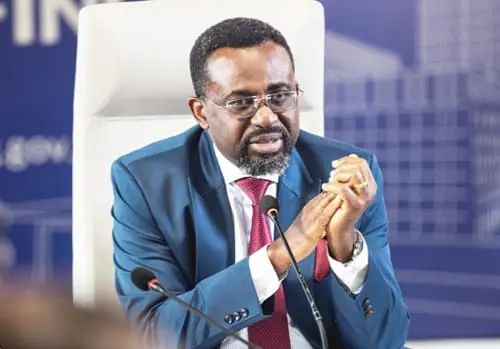
The Governor of the Bank of Ghana (BoG), Dr Johnson Asiama, has appealed to the Finance Minister, Dr Cassiel Ato Forson, to consider a sustainable financing structure for the Ghana Gold Board’s (GoldBod) trading model.
Responding to questions about the losses borne by the Bank of Ghana on behalf of GoldBod in its gold purchasing activities, Dr Asiama noted that support from the Finance Ministry would be crucial. According to him, the GoldBod’s operations form a significant part of the Gold for Reserves programme, which has contributed to strengthening the country’s reserves.
Speaking at the Public Accounts Committee hearing on Monday, Dr Asiama remarked that it’s not a question of shutting it down but enhancing its efficiency, looking at the inefficiencies and taking them out.
“The best thing now, in the national interest, is to look again at the trading model and to, for example, decide: should the Ministry of Finance make a budgetary allocation to take care of the costs, given that this is supporting our reserve build up? Those are the type of questions we need to agree on,” he stated.

He added that the central bank had already made progress in addressing some of the inefficiencies and called for a collective national effort to ensure the success of the programme.
“In the case of the Gold for Reserves, as the name suggests, the objective was to help us build reserves, and the evidence is clear,” he added.
“You will see the reductions that we have brought to bear. So going forward, let’s look at these aspects that we can fix in the interest of the country. And it calls for a unified approach,” he explained.
Dr Asiama emphasized the need for a policy rethink on how GoldBod is financed to avoid further financial pressure on the BoG. He stressed that programme sustainability in 2026 could no longer rest solely on the central bank, adding that going forward, responsibility would be shared so that sustainability does not depend on any single institution.
The Bank of Ghana has been under scrutiny in recent weeks after the International Monetary Fund (IMF) revealed in its fifth review of Ghana’s ongoing IMF programme that losses from the artisanal and small scale gold transactions under the programme had reached US$214 million by the end of September 2025.

While GoldBod itself has indeed recorded profits, those gains have come at the expense of the central bank, which has absorbed the bulk of the losses generated by the programme.
Meanwhile, the Majority Caucus in Parliament has rebutted the claim. The Caucus said the amount was a transactional and insurance cost the GoldBod incurred in its gold trading activities for 2025.
Earlier, speaking at the 77th Annual New Year School and Conference at the University of Ghana, Dr Asiama defended the domestic gold purchase initiatives, describing them as necessary interventions introduced during severe economic distress. He acknowledged the central bank bore substantial financial costs to shield the economy from deeper shocks.

The Governor explained that the Domestic Gold Purchase Programme (DGPP) was conceived during a period of stress and transition when conventional economic buffers were weakening and confidence in the economy remained fragile. The initiative aimed to leverage Ghana’s natural resources to rebuild foreign exchange reserves, stabilize the cedi, and create fiscal space for economic recovery.
“As you will recall, the domestic gold purchase programme was introduced at a moment of acute vulnerability, when foreign exchange buffers were thin and confidence was under significant pressure,” the Governor stated.
He noted that settlement risks were reduced through the introduction of payment before release requirements and the ring fencing of off take proceeds, while pricing structures were improved through reductions in discounts, agent fees, and assay charges. He added that the institutional role of GoldBod had enhanced coordination across the gold value chain.
Looking ahead to 2026, the Governor said the Gold for Reserves programme must be more firmly anchored within the broader Government of Ghana framework as a shared national priority, with responsibilities distributed to ensure long term sustainability rather than reliance on a single institution.
Dr Asiama encouraged informed debate, evidence based analysis, and diverse perspectives on critical national programmes such as the DGPP, stressing that sound policy outcomes were strengthened through transparency and collective responsibility.
The Bank of Ghana, in collaboration with the GoldBod and the Ministry of Finance, will convene a focused policy workshop with experts, market practitioners, and policymakers to examine how the programme can be further refined in line with best practices elsewhere.
Dr Asiama said the GoldBod was no longer a concept but operational and has been embedded within the country’s macroeconomic framework, reshaping how Ghana captures value from its gold resources while strengthening external buffers.
“The relevant question is therefore not whether GoldBod should exist, but how it should be governed, refined, and sustained in the national interest,” the Governor stated.
On the broader economy, Dr Asiama said the stability recorded in 2025 was an enabler for future growth. “If last year was about restoring confidence, then 2026 must be about putting that confidence to work productively,” he noted.